
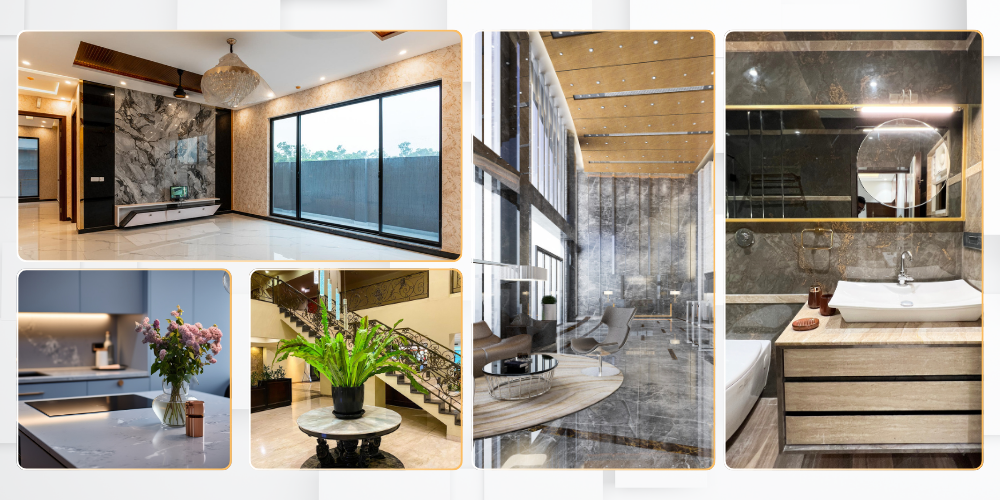
Porcelain slabs are increasingly specified across residential and commercial projects for their ability to combine large-format surfaces with reliable performance. Their suitability extends beyond visual appeal, addressing functional requirements such as durability, surface consistency, and adaptability across different environments.
- Flooring in Residential and Commercial Interiors
One of the most common applications of porcelain slabs is flooring, particularly in spaces where continuity and durability are important.
- In residential settings, slabs are used in living areas, kitchens, and circulation spaces to create seamless surfaces with minimal joints.
- In commercial interiors such as offices, retail spaces, and showrooms, their resistance to wear and ease of maintenance make them suitable for regular foot traffic.
- Wall Applications and Vertical Surfaces
Porcelain slabs are widely used for interior wall cladding and feature walls, where uniform surfaces and controlled finishes are essential.
Their low water absorption makes them suitable for bathrooms, kitchen backsplashes, and other moisture-prone areas. In commercial interiors, slabs are often specified for reception areas, corridors, and statement walls, where clean surfaces and long-term stability are required.
- Countertops and Work Surfaces
- Porcelain slabs are also used for kitchen countertops, island tops, and work surfaces in both residential and commercial environments.
- Their dense structure and resistance to moisture and staining make them practical for daily use. In these applications, slabs are typically cut and fabricated, making surface stability and edge performance especially important.
- Porcelain slabs provide a balance between functional reliability and design flexibility for worktop surfaces.
- Commercial and High-Traffic Spaces
In commercial projects, surface materials are expected to perform consistently over extended periods.
- Porcelain slabs are specified in hospitality spaces, retail interiors, public buildings, and institutional environments where durability and ease of maintenance are priorities.
- Their ability to cover large areas efficiently makes them suitable for projects that require both scale and uniformity, provided manufacturing consistency is maintained.
Closing Note
The application of porcelain slabs across residential and commercial spaces reflects their adaptability and functional performance. Understanding where slabs are used and the requirements of those environments- helps architects, designers, and buyers select surfaces that support both practical needs and long-term reliability.